
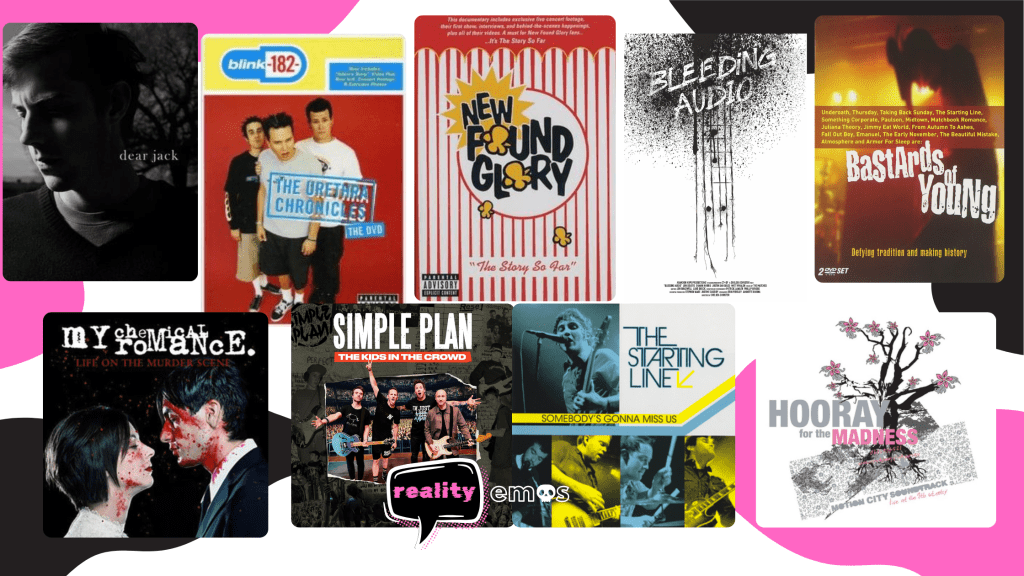

Now, as many of artists are being dragged for standing up against fascism, defending queer and trans rights, or calling out injustice mid-set, it’s time to revisit the “why” behind this scene we love and adore. It was never apolitical. It was never passive. It was never meant to blend in. It was meant to be a voice – and give a voice for the “othered”.
I recently decided to find some sanity in the scene by binging and revisiting every documentary I know of in this alt multiverse – to remember the “why” behind the music.
So, dim the lights, cue the static of old tour footage, and let’s talk about what this music has always been about – resistance, survival, and the strange power of being seen. Emo and alt-punk weren’t just genres for eyeliner and angst. They were lifelines. Created by kids growing up in broken towns, unstable homes, or under systems where they didn’t fit in…this music gave us a way to scream back. To say, I exist. I feel. I won’t play along.
These documentaries go deeper than just tour buses and backstage antics. They pull back the curtain on what made these bands need to create. Some found their escape through horror, others through humor, and many simply through survival. And whether they were screaming in basements or bleeding onstage, the message was always the same: You’re not alone.
“Bastards of Young”: Chaos Caught on Tape
There isn’t a doc that feels as raw, as comprehensive, and as unplugged as Bastards of Young (2005). It takes us into sweaty basements and chaotic shows with bands like Midtown, Paulson, Fall Out Boy, Starting Line, Thursday, Taking Back Sunday – all under the Drive-Thru/eyeball-era angst. It’s emo before the fame, before the filter – when sweat and sincerity were the currency of connection.
This isn’t a just documentary, it’s evidence of the early blueprint of pop-punk’s rawest years. It’s grainy. It’s unpolished. It’s perfect. These were bands making something out of nothing. Shouting from basements with the volume cranked loud enough to drown out apathy. It’s DIY in its truest form – it’s grainy footage, candid confessions, fumbled growth, unfiltered emotion as protest. The politics weren’t overt, but they were in the choice to be loud, to be vulnerable, and to make space for misfits.
“Somebody’s Gonna Miss Us”: Starting Line, Stopping Time
The Starting Line always sang like they knew the world wasn’t built for soft hearts. This documentary captures the tension between wanting to grow up and not wanting to let go…of the band, the fans, the feeling. It’s about identity, transition, and honoring your roots even as you evolve. A quiet, powerful love letter to anyone who’s ever had to say goodbye before they were ready.
Not only do you truly understand why the hiatus was fair for the bands’ members – the anomaly that is Kenny Vasoli becomes even more anomaly-ful (this is a word now) once you give this a watch as well. Acting as the glue to this talented band as early as 15 years old and for so long…all the props must go to that absolute legend.
If you’ve ever screamed “The Best of Me” like your life depended on it, The Starting Line’s “Somebody’s Gonna Miss Us” (2009) will undoubtedly gut you. Released in 2009 but capturing the final days of their 2008 tour, it’s a love letter to fans, a reflection on growing up in the scene, and a tender postscript to an era when pop-punk was still king of the cul-de-sac.
“The Urethra Chronicles”: Blink-182 and the Art of Emotional Immaturity
Blink always got the “immature” label, but look closer. This doc captures a trio of trauma survivors laughing through the hurt. It’s toilet humor, sure…but it’s also boys who never got to be boys, trying to heal through connection, chaos, and the loudest power chords they could find. There’s heart buried in the hysteria. Blink’s refusal to be serious was serious. Because when the world hurts, sometimes laughing until you cry is the only way to not implode.
Blink‑182: The Urethra Chronicles (1999) still feels like the reckless diary entries of pop-punk’s most charming degenerates. This two parter serves as the raw tape of their mayhem: backstage jokes, pranks that go too far, and honest-to-God moments of vulnerability. Here, irreverence isn’t a façade, it’s part of the emotional scaffolding that supports music that makes fun of the “norm” and makes “weird” cool again.
“The Kids in the Crowd”: Simple Plan’s Pop-Punk Therapy Session
Simple Plan never played it cool, and that’s what made them cool. This documentary follows them across 25 years of honesty, awkwardness, and emotional transparency. They were mocked for making sad songs for teenagers- when really, they were creating anthems for survival. The Kids in the Crowd reminds us that vulnerability is community-building. That showing up for fans who felt weird, broken, or left out wasn’t just a marketing tactic – it was the mission.
Simple Plan: The Kids in the Crowd (2025) is a polished, surprisingly intimate portrait of a band still fighting for its place 25 years in. It’s glossy, yes, but also filled with heart: early jam sessions, MTV highs, and that deeply relatable tension of balancing personal pain with professional polish. If “I’m Just a Kid” raised you, this one will hit hard.
“Dear Jack”: Leukemia, Lyrics, and Living Loudly
Andrew McMahon didn’t just survive cancer…he documented the process, publicly and painfully, at the peak of Jack’s Mannequin’s rise. Dear Jack is about more than illness; it’s about defiance. A reminder that vulnerability is strength. That speaking your pain isn’t weakness, it’s rebellion in a world that demands silence. It’s a must-watch for anyone who understands the urgency behind every lyric that feels like a last breath.
A real emotional haymaker, Andrew McMahon’s Dear Jack (2009), is a documentary chronicling Andrew McMahon’s leukemia diagnosis at the height of Jack’s Mannequin’s rise. It’s not just about his illness, it’s about fear, resilience, and music as a lifeline. It’s devastating and beautiful. And it makes you want to hold your favorite albums a little closer.
“Bleeding Audio”: The Matches and the Punk That Couldn’t Sit Still
This is punk on the edge of a nervous breakdown. The Matches were brilliant, genre-bending, and criminally overlooked. Bleeding Audio tells their story like a mixtape of every almost-made-it artist who sacrificed stability for art. It’s a look at the cost of trying to stay true while navigating a system built to exploit. It’s also a love letter to those of us who refused to pick a lane.
If you need a reminder that the scene always had a weird, indie-punk pulse beneath its emo core, The Matches’ “Bleeding Audio” (2020) delivers. It’s vibrant and vulnerable, capturing the rise, burnout, and rebirth of a band that was always too art-school cool for mainstream punk but too scene to stay ignored.
“Hooray for the Madness”: Motion City’s Midwestern Mayhem
Justin Pierre has always felt like that friend who’s too honest…and that’s what makes this doc special. This is Motion City Soundtrack in all their sweaty, synth-y glory, grappling with identity, addiction, and absurdity. Paired with their 7th Street Entry concert doc, it’s a beautiful contradiction: catchy music about falling apart. It’s also proof that talking about mental health is punk as hell.
Motion City Soundtrack’s “Hooray for the Madness” (2006) and their 7th Street Entry concert doc give us not only killer performances, but a look at a band caught between humor and heartache. The manic energy of Justin Pierre trying to keep it together while literally singing about falling apart? Peak MCS. In a world that rewards masks, is revolutionary.
“Life on the Murder Scene”: My Chem’s Beautiful Breakdown
MCR built a world to survive the one they were born into. This is the emotional thesis of a band that turned pain into mythology and survival into a spectacle. My Chemical Romance’s “Life on the Murder Scene” (2006) feels like more than a tour diary. It’s a survival narrative. It’s eyeliner and screams and riffs alchemized into something theatrical, cinematic, and painfully honest.
You’ll see the cracks behind the bulletproof vests – the grief, the exhaustion, the way My Chem held each other together when everything else was falling apart. For a band often dismissed as melodramatic, this video diary is the emotional backbone of a generation. The fantasy was never about escape, it was about endurance. This doc proves that creating your own reality when the world is unlivable isn’t dramatic…it’s necessary.
“The Story So Far”: NFG’s Guided Tour of Pop-Punk Survival
New Found Glory has always been the reliable older brother of the pop-punk scene – loyal, loud, and just the right amount of unhinged. The Story So Far is less about reinvention and more about resilience.
The doc charts their evolution without ever making it feel like a rebrand. It’s earnest, sometimes awkward, and full of tour footage that shows exactly why they outlasted so many of their peers. New Found Glory didn’t just survive pop-punk’s peak – they stuck around to defend it. Staying true in an industry addicted to trends? We stan this.
Watch this one for straight-up nostalgic joy, New Found Glory’s “The Story So Far” (2013) is a tight, fan-service-y ride through the band’s career, packed with tour footage, candid moments, and just enough chaos to remind you why they were pop-punk’s reliable jocks in a sea of emotional wrecks.
LET’S CHAT
Have any other recommendations for documentaries others should check out? Which of these have you seen? How do you feel about bands and artists vocalizing their opinions about society?
Until next time – Stay emo, stay vocal, and keep the music alive.
 RealityEmos
Leave a comment